
.png)
I used to think a seed was basically a finished product. You plant it, it grows into whatever it was bred to be, end of story. Turns out that's not quite true.
Here's the thing that got me: the exact same seed variety, planted from the exact same batch, can perform completely differently depending on which field it lands in. Same genetics, same starting point, different result. That's not a defect in the seed. It's a real, well-documented phenomenon in plant science, and it's the whole reason this post exists.
In this article: What is G×E → The shapes G×E interaction can take → The old way of measuring "environment" → The part that got left out: soil biology → What the science actually shows → Why this actually matters → FAQ → References
What is G×E, in plain terms?
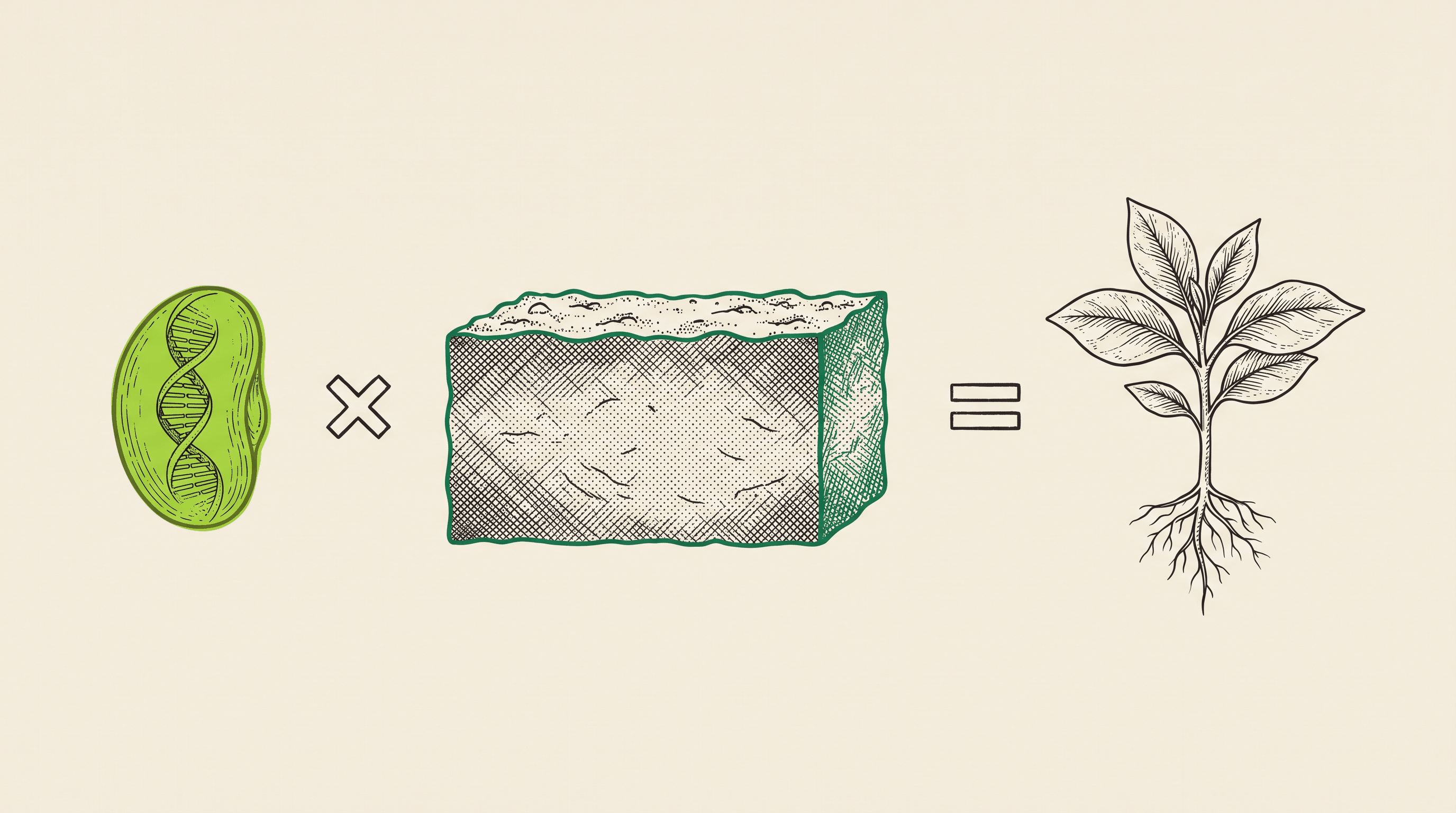
G×E stands for Genotype × Environment, the discovery that a plant's genetics and the place it grows don't just add up, they interact. A variety that's the best performer in one environment isn't automatically the best performer in another. Change the field, and the ranking of "best seed" can genuinely flip.
- Genotype (the G) is the genetic instructions inside the seed. Fixed the moment the seed exists, doesn't change depending on where you plant it.
- Environment (the E) is everything about the place where the seed grows that isn't in the recipe: weather, rain, and, as we'll get into, the soil itself.
Worth knowing a third word too: phenotype, what you actually see and measure at harvest, yield, height, disease resistance. It's the result of the genotype meeting the environment it grew in.
The shapes G×E interaction can take
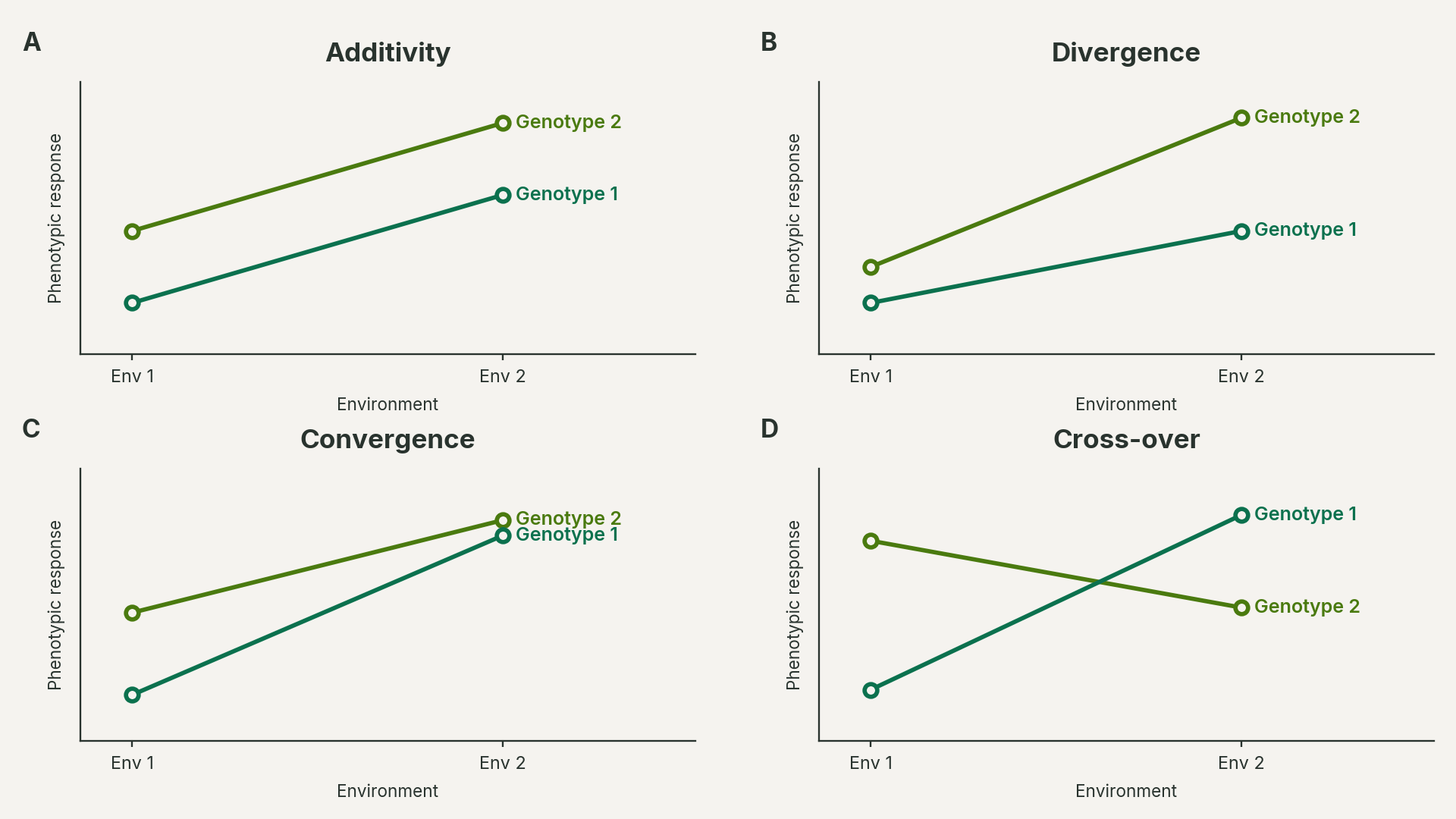
Breeders study G×E for two reasons: to find genotypes that hold up well across many different environments, and separately, to find genotypes that shine only under specific conditions. Comparing two genotypes across two environments reveals four basic patterns:
- No interaction (additive). Both genotypes respond to the environment the same way, one is just consistently better than the other by roughly the same margin everywhere.
- Divergence. Both genotypes improve in the better environment, but the gap between them widens.
- Convergence. The opposite: the gap between the two genotypes narrows in the better environment.
- Cross-over. The pattern that matters most to breeders. The genotype that wins in one environment loses in the other, the ranking flips entirely, exactly what makes picking a single best variety across many farms genuinely hard.
When environments can be lined up along a real gradient (temperature, rainfall, distance), divergence or convergence tend to show up more often than a full cross-over.
G×E also affects how well a genotype's result in one environment predicts its result in another, the Type B genetic correlation. When G×E is large, that correlation is low, performing well in one environment tells you little about a very different one. Only environments that are actually similar in the traits that matter tend to correlate strongly. This is part of why we think soil deserves more attention: if soil biology is a real, previously unmeasured slice of "environment," soil similarity between two fields, not just climate similarity, may be part of what makes their results predictive of each other, or not.
(Framework paraphrased from Dr. Vanessa Cave's VSNi article, cited in references, not quoted, the chart is our own build.)
The old way of measuring "environment"

For a long time, "environment" mostly meant what a weather station measures: temperature, rainfall, sunlight hours. Soil, when it appeared at all, was usually reduced to a chemistry report: pH and a few nutrient levels.
Useful, but incomplete, it treats soil like a container of chemicals and leaves out the fact that soil is, quite literally, alive.
The part that got left out: soil biology
.png)
A single handful of healthy soil can contain billions of microorganisms, bacteria, fungi, and other tiny life forms, interacting with plant roots. This community, the soil microbiome, varies field to field in ways that don't always track pH, texture or nutrient levels, and it actively shapes how a plant grows.
So when the same seed variety behaves differently in two fields with similar weather and pH, the soil microbiome is one of the most likely places to look for the missing explanation, and it's the piece that's historically gone unmeasured.
What the science actually shows (kept honest)

- Studies on specific plants (e.g. Lotus japonicus) found the genotype × soil-microbiome interaction has a bigger effect on growth than either factor alone.
- A plant's own genetics partly determines which microbes it attracts into its root zone, so genotype and soil-environment aren't fully separate categories.
What this doesn't mean yet: that we can point to one microbe and say "this is why yield dropped." Soil biology is a real, measurable, previously underweighted piece of G×E, not a fully solved puzzle.
Why this actually matters

If part of the "unexplained noise" in a multi-site trial is actually unmeasured soil biology, that changes how you read the data. Instead of "that field is just unpredictable," there's now a concrete, measurable factor to check, relevant to variety placement and how confident to be in a "yield stability" claim.
I came into this expecting a purely technical topic, and found something closer to a detective story: the same clue (a seed's genetics) producing different outcomes, and a suspect (soil biology) that's been sitting in plain sight, never properly investigated.
FAQ: common questions about G×E
What is genotype × environment interaction (G×E)?
G×E is when a plant variety's relative performance changes depending on where it's grown, not just scaling up or down evenly, but its ranking against other varieties actually flipping from field to field. A variety that wins the trial at one site can lose it twenty kilometers away.
Why does the same seed variety perform differently in different fields?
Because "environment" isn't one variable, it's the sum of everything the seed didn't come with. Weather is part of it, but so is soil, and soil in particular varies from field to field in ways that have historically gone unmeasured, especially the biological part (the microbiome), not just the chemistry and texture.
Does soil affect G×E?
Yes. Soil chemistry (pH, nutrient levels) and texture (sand/silt/clay) have long been part of G×E research. What's newer is evidence that soil biology, the microbial community around plant roots, is a large and previously under-measured part of that variation, and that a plant's genotype and its soil microbiome actively interact rather than acting independently.
How is G×E measured?
Breeders mostly rely on stability analysis from multi-environment trials. The two most commonly used approaches are AMMI (Additive Main Effects and Multiplicative Interaction) and GGE biplot analysis, both designed to separate how much of a variety's performance is a stable genetic effect versus environment-driven variation.
Why does G×E matter for plant breeding?
Because breeders have to decide which varieties to advance based on multi-site trial data, and G×E is exactly what makes that decision hard. A variety that looks best on average across sites might not actually be the best choice for any single farm, and mistaking environmental noise for a real genetic difference leads to picking the wrong variety.
Can G×E be reduced or managed?
Not eliminated, it's a real biological phenomenon, but it can be managed by understanding it better: matching varieties to the actual conditions, including soil, of the fields they'll be grown in, rather than searching for one variety that's "best" everywhere.
References
- Dr. Vanessa Cave, G×E Interactions in Breeding Programs Explained, VSNi (source for the additive/divergence/convergence/cross-over framework and Type B genetic correlation, paraphrased above, not quoted)
- Genotype × Environment (GxE) in Forestry Breeding, VSNi
- Genotype-Environment Interaction, ScienceDirect Topics
- Genotype by Environment Interaction Modeling, U. Wisconsin–Madison
- Soil microbiomes: a promising strategy for boosting crop yield, Discover Agriculture, Springer Nature
- Synergistic effects of plant genotype and soil microbiome on growth in Lotus japonicus, PMC
- The soil microbiome of Lolium perenne depends on host genotype, PMC
- Stability Indices to Deciphering the Genotype-by-Environment Interaction (GEI) Effect, PMC (AMMI/GGE reference for the FAQ)


.svg)
.svg)