.png)
By Dr. Matthias Schaks, Lead Scientist at Soilytix | Updated July 2026
The ITS region is the standard DNA barcode for fungi, but for years most soil fungal metabarcoding has read only its first part, ITS1, because short-read sequencing could not cover the whole thing. Extended-read Illumina technology changes that. It now sequences the full ITS1-5.8S-ITS2 region at around 1,000 base pairs while keeping the single-base accuracy of short-read platforms. The result is more taxonomic coverage and, above all, better species-level resolution, without trading away data quality.
TLDR
- The ITS region is the accepted DNA barcode for fungi. Most fungal metabarcoding has used only its first sub-region, ITS1, because short-read Illumina could not span the full region
- Extended-read Illumina (MiSeq i100 Plus, 2 × 500 bp) now recovers the full ITS1-5.8S-ITS2 region at around 1,000 bp, while preserving the single-base accuracy needed for reliable amplicon sequence variants (ASVs)
- In an in silico test against the Eukaryome database, full ITS raised genus-balanced taxonomic coverage to 85%, versus 77% for ITS1, with fungal specificity maintained
- On a standardised 10-species mock community, full ITS identified 8 species to species level versus 5 for ITS1. Genus-level identification was reliable with either assay
- In complex soil samples, full ITS assigned a higher proportion of sequence variants to both genus and species level
What is the ITS region, and why is it the fungal barcode?
The internal transcribed spacer (ITS) region sits in the ribosomal RNA operon, between the 18S and 28S genes. It is made up of three parts: ITS1, the 5.8S rRNA gene, and ITS2. It became the formally accepted barcode for fungi because it varies enough between species to tell them apart, while being flanked by conserved regions that primers can reliably target. That combination, variable in the middle, predictable at the edges, is exactly what a good barcode needs.

Figure 1: Genomic location of the ITS region. The rRNA operon, including the 18S rRNA gene (left), the ITS region, being comprised of the ITS1 part, 5.8S rRNA gene, and the ITS2 part (middle), as well as the 28S rRNA gene (right) is depicted. The region that is amplified by primers either targeting ITS1 or the full ITS region (ITS1–5.8S–ITS2) is shown at the bottom. The figure was modified from Tedersoo et al., 2018.
Fungal communities matter across natural and managed systems: they drive nutrient cycling, plant health, and soil structure. For plant breeding and agricultural input development, high-resolution fungal data help separate beneficial taxa from pathogenic ones and support the development of more resilient crops and effective biological products. As regenerative practices spread, reliable fungal monitoring becomes more important, not less.
Why has fungal metabarcoding been limited to ITS1?
The constraint was practical, not biological. Conventional Illumina workflows read up to 2 × 300 bp, which is roughly 600 bp once paired reads are merged. That is not enough to cover the full ITS region with confidence, so laboratories targeted only ITS1, the shorter sub-region, as a workable compromise.
Long-read platforms such as Oxford Nanopore and PacBio can sequence the full-length ITS, but they involve trade-offs in per-read accuracy and consistency. So the field was left with a gap: short reads were accurate but partial, long reads were complete but less consistent per base. Neither gave you the full ITS at short-read quality.
What changed, and how does full ITS sequencing work now?
Benchtop sequencing caught up. The Illumina MiSeq i100 Plus platform introduced extended read configurations up to 2 × 500 bp, using 1,000-cycle chemistry, which enables sequencing of amplicons around 1,000 bp long. That removes the key bottleneck in fungal metabarcoding.
The updated workflow pairs optimised primers targeting ITS1-5.8S-ITS2 with extended paired-end sequencing, recovering the entire ITS region: ITS1, the 5.8S rRNA gene, and ITS2 together. Sequencing the full region adds phylogenetic information, which improves discrimination between closely related taxa, while keeping the reproducibility and single-base accuracy that short-read platforms are known for.
How much more does full ITS actually detect?
Three lines of validation point the same way, and they are worth reading together rather than in isolation.
First, coverage. In in silico PCRs against the Eukaryome reference database, using one randomly chosen sequence per genus to avoid bias from over-represented taxa, the full ITS assay reached 85% genus-balanced taxonomic coverage, compared with 77% for ITS1. Both assays stayed highly fungal-specific, so the gain does not come at the cost of amplifying off-target sequences.
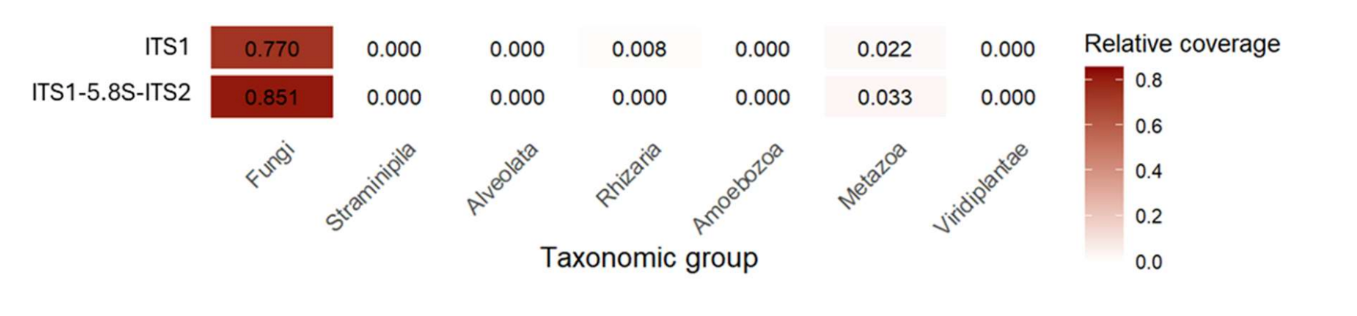
Figure 2: Taxonomic coverage of full ITS metabarcoding. In silico PCRs were performed with either primer pairs targeting ITS1 or with primer pairs targeting the full ITS region. After primer optimization (not shown), genus-balanced taxonomic coverage increased to 85%, as compared to 77% when using the primer pairs targeting the ITS1 part. Note that both assays specifically amplify fungal ITS sequences, thus minimizing off-target amplification.
Second, species-level identification. Using the standardised MSA1010 (ATCC) mock community of ten fungal species, analysed with the dada2 pipeline and the UNITE database, the full ITS assay correctly identified 8 of 10 species, against 5 of 10 for ITS1.
This is the key point: genus-level identification was reliable with either assay, so the real advantage of full ITS is at the species level, where it resolved three additional species that ITS1 could only place to genus.
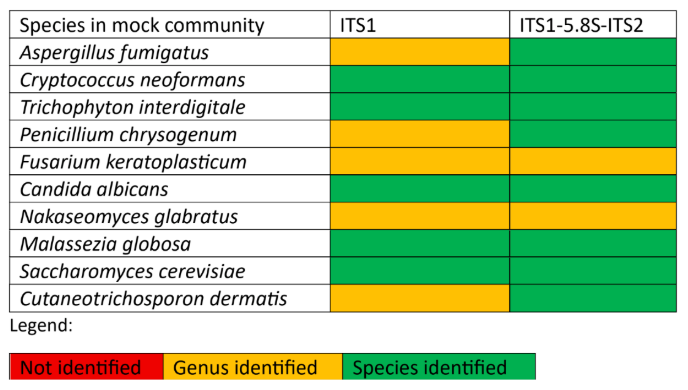
Figure 3: Species identification using mock community. The MSA1010 (ATCC) mock community standard was used to assess the species-level identification capability of both the ITS1, as well as the full ITS (ITS1-5.8S-ITS2) assay. Genus-level identification only is shown in orange, while species-level identification is shown in green. Note that the full ITS assay is able to successfully identify 8 out of 10 fungal species.
Third, real soil. Across seven complex soil samples, full ITS metabarcoding assigned a higher proportion of sequence variants to both genus and species level than ITS1. The improvement seen in the mock community carries over to the messy reality of environmental samples, which is where it matters for applied work.
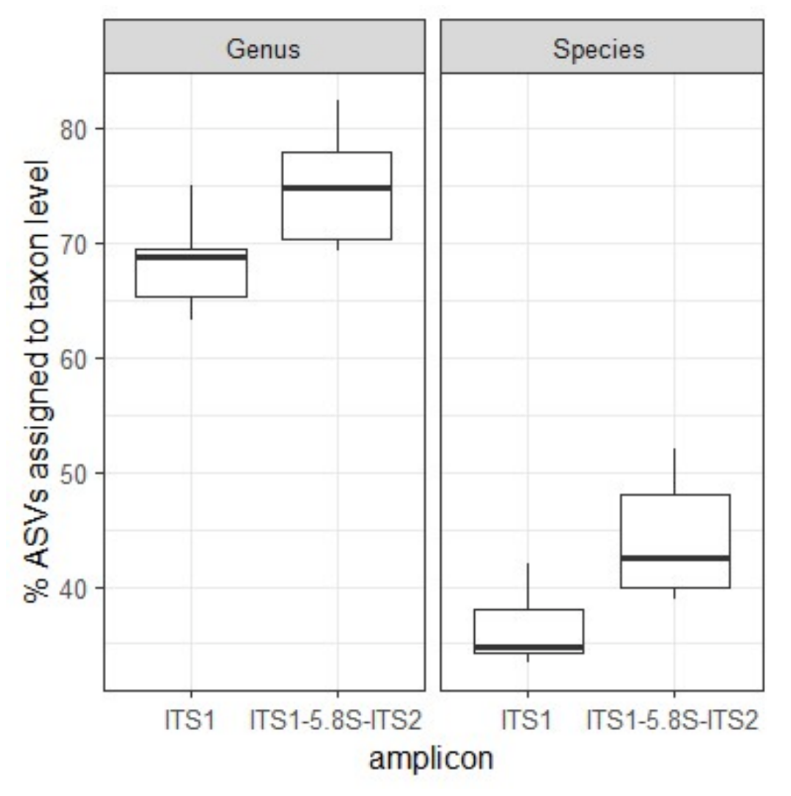
Figure 4: Enhanced taxonomic resolution of complex soil fungal microbiomes. Seven soil samples were subjected to both ITS1 and full ITS metabarcoding and ASVs were obtained using the dada2 pipeline. Taxonomic assignment was achieved using the UNITE database. The proportions of ASVs being assigned to genus and species level, respectively, are shown. Note that the full ITS assay provides an augmented ASV assignment to both genus and species level.
Does this replace long-read platforms like Nanopore and PacBio?
No, and it is not meant to. Those platforms remain valuable and have their own strengths, including reads that go beyond the ITS region entirely. The point is narrower: extended-read Illumina now delivers the full ITS while preserving the per-base accuracy and reproducibility of short-read sequencing. That removes the main reason ITS1 was used as a compromise in the first place.
As with any assay, the right choice still depends on the question being asked.
For fungal profiling in breeding trials, biological product development, and soil health monitoring, the decision-relevant signal often lives at the species level: telling a beneficial species apart from a pathogenic relative, or tracking one specific taxon over time. Genus-level questions were already well served by ITS1.
Full ITS sequencing extends the reach to species-level answers and improves overall coverage, without giving up the data quality that makes results reproducible. That is the practical case for the transition.
Working on fungal profiling for a trial, a biological product, or a soil health study? We are happy to talk through which ITS approach fits your question. [Get in touch with the Soilytix team.]
Want the full methodology and data? [Download White Paper #11: Advancing Fungal Amplicon Sequencing: Transition from ITS1 to Full ITS1-5.8S-ITS2 Profiling.]
References
- Tedersoo L, Tooming-Klunderud A, Anslan S (2018). PacBio metabarcoding of Fungi and other eukaryotes: errors, biases and perspectives. New Phytologist 217:1370-1385. doi:10.1111/nph.14776
- Tedersoo L et al. (2024). EUKARYOME: the rRNA gene reference database for identification of all eukaryotes. Database 2024:baae043. doi:10.1093/database/baae043
- Abarenkov K et al. (2024). The UNITE database for molecular identification and taxonomic communication of fungi and other eukaryotes. Nucleic Acids Research 52(D1):D791-D797. doi:10.1093/nar/gkad1039
- Callahan B, McMurdie P, Rosen M et al. (2016). DADA2: High-resolution sample inference from Illumina amplicon data. Nature Methods 13:581-583. doi:10.1038/nmeth.3869


.svg)
.svg)